About the Journal
Asian Multidisciplinary Research Journal of Economy and Learning (AMJEL) is a peer-reviewed, open-access journal dedicated to advancing the fields of economy and education through multidisciplinary research. AMJEL provides a platform for scholars, researchers, and practitioners to share innovative ideas, findings, and experiences that contribute to the understanding and improvement of economic and educational practices in Asia.
| Journal Title | : Asian Multidisciplinary Research Journal of Economy and Learning |
| Initials | : AMJEL |
| Frequency | : Monthly |
| E-ISSN | : 3063-1424 (https://portal.issn.org/resource/ISSN/3063-1424) |
| Chief Editor | : Arga Abdi Rafiud Darajat Lubis, Scopus ID: 59826865700 |
| DOI Prefix | : 10.70471 |
| Publisher | : CV. ARGA FARMA |
| Accreditation |
:Google Scholar, Garuda, RePEc, Crossref, Copernicus, Base, Member of APJI, OneSearch |
 |
 |
 |
 |
 |
 |
 |
 |
 |
 |
Current Issue
Vol. 3 No. 10 (2026): Culture and Connectivity in Sumatra: Dance Learning, Infrastructure Recovery, and Agricultural Access
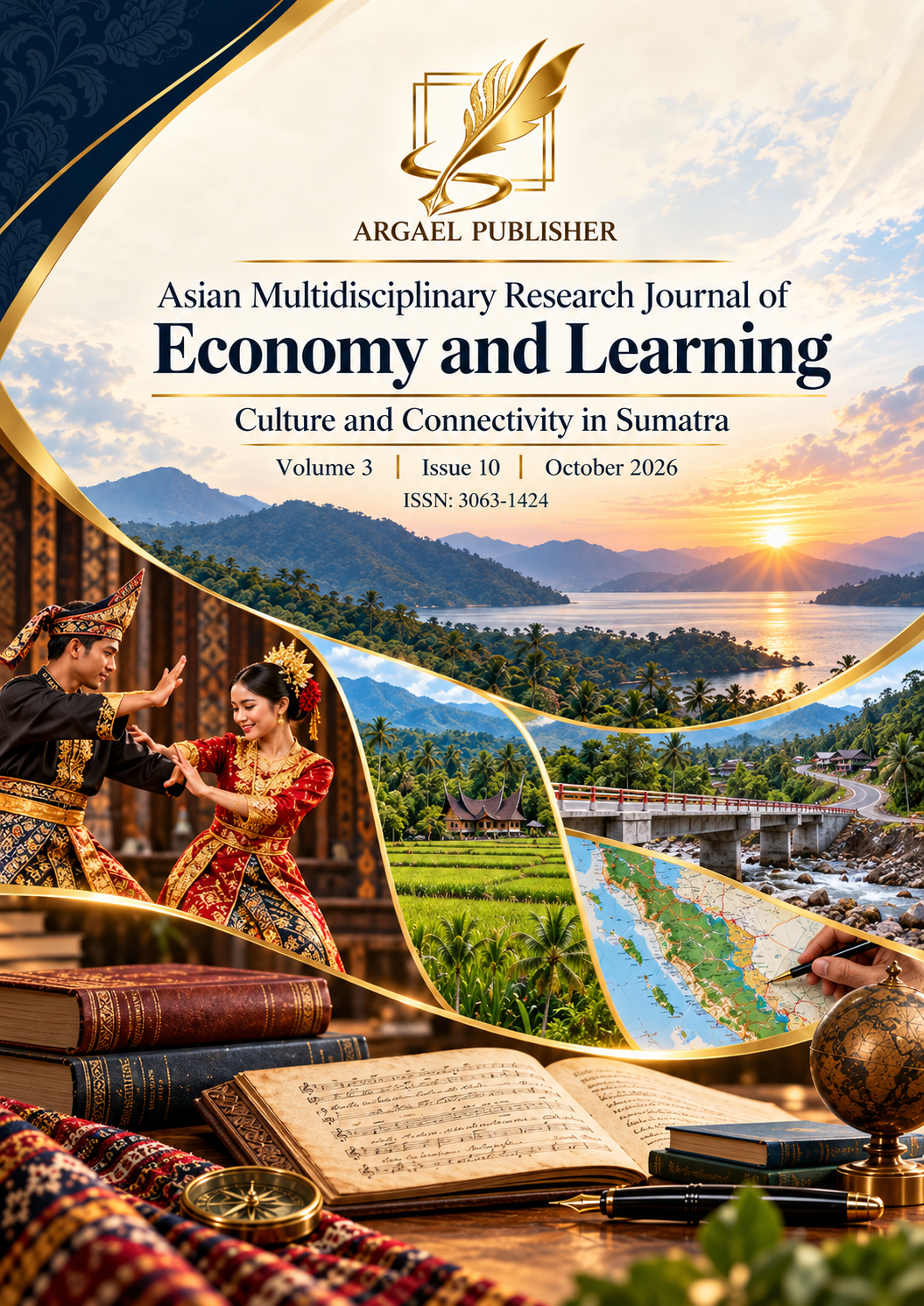
This issue presents two articles that use documentary sources to examine questions of learning and of regional economic development. Each article is careful to state what its sources can and cannot establish. Kurnia (AMJEL.118) analyses an undated report on the Tanjung Katung/Lagu Dua dance materials attributed to Guru Sauti (1957). The article separates what is visible in the report, what the report claims, and the author’s own interpretation. From this it proposes a five-stage learning sequence for teaching Malay cultural heritage when the documentary record is uncertain. Samosir, Mulia, and Revida (AMJEL.119) build a source-located chronology of infrastructure damage, recovery measures, and agricultural exposure in Southeast Aceh from 2024 to October 2026. They identify conditions relevant to agricultural connectivity and resilience without claiming causal effects. Together, the two articles show that rigorous document analysis can support both cultural education and evidence-based regional planning.
Published:
2026-10-31